
Podcast: Play in new window | Download
0062 Buying Silver and Gold MP3
(audio player at bottom of page)
Buying Silver and Gold
by Ben Stone
I’m not sure how many times I’ve been asked about precious metals lately but it comes up often enough that I finally decided to try and put my thoughts all in one place.
Please note: I am not affiliated with any sellers of precious metals and make no commissions whatsoever. I am not giving financial advice. I am simply sharing what I have learned. If you know something I don’t know, please feel free to add it to the comments below this article. As always, be polite and helpful and your opinion will be respected.
Why would a person want to own precious metals (PMs)?
I think there are three possible answers to that question, but for me there is only one. PMs are a way to store wealth. But lets take a quick look at the other two reasons.
1) Investing in Collectibles
Whether in the form of jewelry, rare coins, or commemorative objects, collectibles are often made of PMs. However, trading in the collectibles market is risky and requires a lot of specialized knowledge. Also if the economy turns bad, and I mean real bad, no one will care if your gold “clad” commemorative Buck Owens belt buckle once sold for $300. If the economy is bad enough it will only be worth its melt value because no one may care who Buck Owens was or why a belt buckle has his face on it.
So I never invest in collectibles.
2) Playing the PM market for profit
While on the surface this may seem like a good idea considering the current trends in the PM market, this also requires specialized knowledge and is very risky at best. Playing any commodity for profit is one of the more difficult forms of the stocks and bonds market.
So I never try to play the PM market.
What am I talking about when I say I own PMs as a way to store wealth?
Here’s the classic example:
In 1810 a fine hand tailored man’s business suit cost 1 oz of gold.
In 1910 a fine hand tailored man’s business suit cost 1 oz of gold.
In 1910 the dollar was determined by gold, and 1 oz of gold cost $20.
Actions taken in 1913, 1933, 1944, and 1971 removed the connection between gold and the US dollar.
In 2010 a fine hand tailored man’s business suit still cost 1 oz of gold but now cost 1200 US dollars.
So the value of gold stayed pretty much the same, but the value of the dollar is only 1/60 of what it was worth in 1910. That’s a 98% devaluation and most of that devaluation has happened since 1971.
Here’s another classic example of how the dollar has been devalued.
In 1963 a US Quarter coin was made mostly of silver and could buy 1 gallon of gas.
In 2010 a gallon of gas cost about $2.80 but that same day the silver in a 1963 quarter was also worth $2.80.
So from 1963 to 2010 silver and gas stayed about the same, but dollars devalued by 90%.
In these examples I use 2010 because all market prices including gold, silver, suits and gas are changing rapidly and will become more volatile in the years to come, but PMs will always settle to roughly the same real value. Dollars will, however, constantly be worth less and less until they are worth nothing.
So buying precious metals is not a way to make money, it’s a way to preserve the value of the wealth you already have.
Ok, then…
Why has the dollar devalued by 98% since 1910 and by 90% since 1963?
That question can be taken different ways and has several answers.
The methods used to devalue the dollar were the act of printing new money and the mechanism of credit expansion. In other words, the US Treasury Department can just print new money. But most new money came from the banking system under the Federal Reserve. The Fed makes new money by loaning it into existence.
Keep in mind; the Fed is not a part of the government. It’s a private bank. It is a private bank that can make its own money any time it wants without asking the government. The congress and the president of the US gave the Fed that power in 1913.
Every time The Treasury or the Fed pumps more new money into the system, every dollar is worth a little less because there is more of them.
Now ask yourself this question:
If you ran a bank and you could just make new money whenever you wanted, how much self-control would you have?
Some people believe this devaluing of the dollar and destabilizing of the US economy has been done intentionally by people who want a global currency and ultimately a one world government. But whether by shortsighted greed induced stupidity, or whether by evil men seeking to dominate the world, the end result is the same.
(see my article titled Evil or Stupid)
Where is this all headed?
Whether for good or evil, we are headed for a global currency. But to do that a massive amount of wealth will be transferred out of the hands (and retirement funds) of working Americans, Canadians, Europeans, and Australians.
What can a person do to protect their savings?
Store your wealth in precious metals. And here are some tips on how to do just that.
Rule #1
Avoid numismatics (collectors items)
Some terms you don’t really need to know:
Numismatic – these have collector value due to some factor (composition, rarity, beauty, etc) beyond the melt value of the metal.
Legal tender – can be used to pay debts in some currency (dollars, yen, pounds, euros, etc) and sellers are currently forced to accept them by law.
(American silver eagles are both numismatic and legal tender, but one doesn’t imply the other.)
Common circulated pre-1964 silver dollars, quarters, and dimes, are legal tender, but are not collector’s items.
Liberty Dollar’s Ron Paul coins and coins sold on TV are not legal tender, but are collector’s items.
Generic bullion is not legal tender, and not collector’s items. It’s simply metal. This is what we want.
Now for some things to remember.
Buying Tips
One of the safest ways, in my opinion, to buy PMs is by purchasing rounds and bars (generic bullion) through a trusted dealer.
At the bottom of this article I provide links to online sellers that I have done business with and trust. It’s also good to get to know a couple local coin dealers by dropping by their shop and buying a silver round or two every few weeks. When you go to a coin shop, carry cash. They most likely won’t take plastic of any kind and may or may not accept checks.
Common circulated pre-1964 silver dollars, quarters, and dimes are called “junk silver” and are generally about 90% silver. Some people prefer these coins to rounds and bars, but I find the whole process cumbersome and confusing. They are a good way to buy silver, but require a whole different set of rules for purchase so I don’t recommend junk silver as a person’s entry into PMs.
Likewise, old silverware and silver place settings are popular with the folks who go to estate auctions, but again unless you know what to look for you’re asking for trouble.
Price
The “spot price” is the current market price, usually in ounces. Always know the spot price when you’re about to make a purchase.
The quickest way to find this is to Google the words spot silver or spot gold. You’ll see several sites like Kitco or Monex. The market keeps these sites honest so you can trust their charts.
Remember, the spot price changes constantly, but honest dealers will base their price on it all the time. Once you know the spot price, expect to pay a bit over that amount. After all, the dealer has to make a living and cover their expenses. Most likely they will charge somewhere between $4-8 an ounce commission. If you’re buying locally from a coin shop, you may have to pay sales tax but if you order online you may be able to skip the sales tax but you will have shipping costs.
Large Purchases
You probably won’t be able to make large purchases at a local coin dealer unless you have built a good business relationship with them. Then they will value your business and trust you and can best guide you in the matter. I’ll only say that once you have a good relationship with a local dealer they may be able to give you significant discounts on their commission when making large purchases.
Storing Your PMs 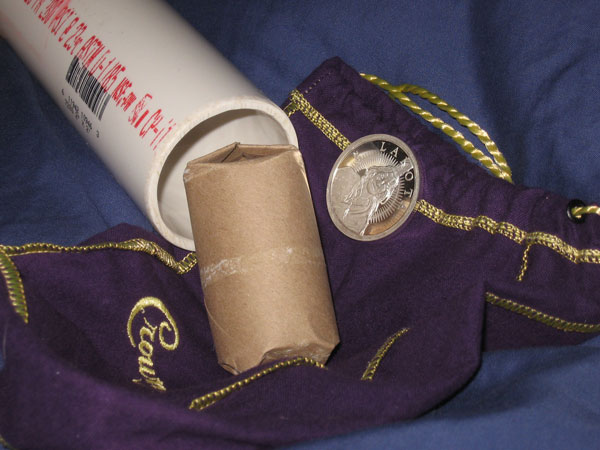
The topic of large purchases quickly brings up the question of what to do with all these rounds and bars. Safely storing PMs is a touchy question and I’ll cover it more fully in a separate article. One thing I don’t recommend is to buy your PMs through the use of “certificates”. This is where banking institutions, dealers, or full-service brokers hold the gold in their vault and issue you a slip of paper and a promise. They do have some advantages and those advantages may be significant, but when you need to get your hands on your investment there can be serious stumbling blocks. Also if the government turns nasty, as the US did in 1933, it can and has confiscated private holdings of PMs and the ones held in certificate form are the easiest for the government to grab.
If, on the other hand, you feel strongly about using certificates I would at least say that you shouldn’t put all your eggs in one basket. And I would recommend using a system where the purchase of the PMs is through a separate organization than the final holder of the PMs. This is the case with AOCS Mint (links below) and The Free Lakota Bank. You can make a safe purchase from AOCS and have it shipped directly to The Free Lakota Bank where they will store it in their vaults. The Free Lakota Bank has a number of advantages to some other institutions, but that’s for another article.
Also moving large amounts of wealth out of retirement funds and into PMs may require the use of stocks in gold producing companies, but I would consider this a last resort rather than taking a giant tax hit on the fund.
Are PM Purchases Tracked or Recorded by The Government
I don’t know about other countries but in the US they are not currently recorded, however that could change.
In 2012, unless the laws change yet again, when you sell anything including PMs over $600 you may have to file tax forms.
Also if you make a purchase of anything greater than $10,000 and you use cash, it will be reported, however it is a “cash reporting transaction.” It is not the PMs that the government wants reported but the cash. Such reporting applies to all business transactions involving more than $10,000 cash. This nonsense is supposed to keep us safe from the drug dealers and the terrorists. But again, this rule is only for cash. It does not apply to personal checks, wire transfers, or money market withdrawals. However, cashier’s checks have layers of goofiness that make them considered both cash and not cash by the idiots that run the insane asylum in Washington DC.
Tarnish
Don’t worry about it. We only care about the weight and the purity, not the looks.
Tarnish is a discoloration that can take place when silver is exposed to some gasses that are naturally found in air. Some air has more of these gasses than other air, so it varies.
If you are worried about it, you can seal the silver in an airtight container and it should help.
Final Thoughts
Another thing about having wealth in the form of PMs is that its a fun way to save while both having the PMs in your hand and not being tempted to cash them in every time you want to splurge on some indulgence.
Also, they make the most impressive gift you can imagine. Rather than giving a friend or relative a mid-value bottle of wine or buying some plastic toy for a child, hand them a Crazy Horse Lakota round and watch their eyes light up.
Ben Stone 
2011
LINKS:
I have personally done business on line with these fine folks and couldn’t be happier with their service.
http://www.silverandgoldshop.com/
http://freelakotabank.com/
http://aocsmint.com/
Note: PMs can be purchased at the AOCS Mint web site and directly deposited into your account at The Free Lakota Bank.
http://shiresilver.com/ <~~ Some interesting options for the liberty minded.
Avoid numismatics: Peter Schiff
http://youtu.be/zbDhMoFvdhM
Advice on moving PMs outside of the US by Mark Nestmann
http://lewrockwell.com/nestmann/nestmann31.1.html