War Is Peace, Freedom Is Slavery, Ignorance Is Strength

WAR IS PEACE
FREEDOM IS SLAVERY
IGNORANCE IS STRENGTH
by Ki Vick

The State would have you believe that its definitions of reality are the truth. It has twisted our minds so much, that things that we think of as “common sense”, when looked at objectively are stunning in their fallacy.

I’m going to talk about regulations today. When we go back to events such as the BP oil spill last year, the common outcry is for the government to “do something” about these businesses that run amok. Most often that “do something” includes making more regulations. If you ask most people the simple question of “do government regulations make businesses more accountable, or less accountable?” the answer is “more accountable!” (often said with a sigh, or eye rolling, to indicate that you’re a simpleton for even asking such an obvious question).

And yet, I do ask the question. Does government regulation make business more accountable? I find the answer to be interesting, if one takes the time to really think the logic through. This particular question comes up often in statist arguments as to why we need the State. They proudly pull this argument out of their pocket, and flourish it about, deafly tuning out any answers you may come up with, because clearly you can’t answer this question. They’ve got you. Common sense says that they’re right. Common sense says that businesses are evil, and will do only that which they are forced to do.

Survival Gear BagsCommon sense is wrong. And I can prove it. I’m going to use an example of how the State has lowered standards for an industry through strict regulations. We should begin by looking at buildings built in the 1700’s and 1800’s. I can do this pretty easily, as there are farmhouses and city buildings dating back to the 1800’s all around me here in southwestern Ohio. If you want to look at buildings built in the 1700’s, you must travel further east, to New York, Boston, and Virginia. This argument is bolstered further by looking at buildings and structures in Europe, father back in history. But we’ll stick with homes built in the 1800’s.

These homes are sturdy. Built with brick, and large beams. These homes stand the test of time. They have wide, sweeping patios and scrollwork on the siding. They are built solidly, and have intricate design work. They are marvels of form and function. And they had no “code” to be built to.

Contrast them to homes built today. I had a boyfriend a while ago who was an electrician and contractor. He would laugh anytime someone asked him if he would rather buy a new home or an old home. He would say, “I’ve seen how they build new homes. I’d never buy one of those pieces of junk.” New homes are built to a government mandated code. This is not a good thing.

If there is no enforced code, then contractors set the code. As a consumer, you decide how much you want to pay, and what you want to get for your money. If contractor Bob has a reputation for doing lackluster work, then you might want to choose contractor Dave, who has a reputation for being more competent. As a consumer, you are free to choose. If you want a long-standing building, you are free to choose contractor Dave, but if you are looking for something cheap and that only has to last a season or two, you can feel free to choose contractor Bob. Regardless, your building will be built to your code, not the code of a government.

However, freedom aside, enforced regulations don’t just make the poor contractor raise his standard (and prices). It doesn’t just affect whether your shed now has to be built to standards ridiculously high for it’s purpose, but it also makes contractor Dave lower his standards. He doesn’t have to work to the highest level now. He only has to do the minimum to pass code. Consumers will want their product to be “up to code” without realizing that “to code” is the MINIMUM. So now, instead of choosing contractor Dave, whose work is above code, they choose contractor Bob, whose work is “up to code” because contractor Bob is cheaper, and “up to code” means it’s safe, right?

So now contractor Dave has to lower his standards to compete with contractor Bob. Instead of using the best products and having a higher price, he now also goes just to code, and prices competitively to Bob. So now we have Dave, the former good contractor, lowering his standards, and Bob, the former bad contractor, raising his standards. Right? Not quite.

See, contractor Bob is never going to be a better contractor. Forcing him to work “to code” is just giving him a minimum he can work to. All he has to do is pass inspection. And that’s pretty easy to do. It also gives him legal protection. If his shoddy work falls apart in two years it’s not his fault, he made it to code.

Having government regulations does not raise business practices. It helps shoddy businesses, while punishing businesses that would have normally had high standards. If you want to have a business strive for greatness, remove the minimum requirements. That puts the accountability back onto the business and the consumer, and out of the government’s hands.

Ki VickKi

2011
Coyote Vick is a staff writer at Bad Quaker Dot Com
More by Coyote Vick can be found at crapimanadult.blogspot.com


Posted in Brief Articles and Short Notes, Free Society, History, Voluntaryism and Law | Tagged , , , | Comments Off on War Is Peace, Freedom Is Slavery, Ignorance Is Strength

Voluntary Taxes: Abusive Language and Politicians

This Week’s Featured Article was pirated from Walter Block, one of the truly great leaders of the liberty movement.

Voluntary Taxes: Abusive Language and Politicians
by Walter Block on Monday, April 25, 2011 at 2:46pm

In his March 20, 2002 letter to the Wall Street Journal “‘Tough-Guy’ Proposals for Indiana’s Budget,” that state’s Governor Frank O’Bannon calls “for increases in two minor, voluntary taxes — on cigarettes and riverboat admissions.”

“Voluntary taxation?” “Voluntary taxation” is an oxymoron if ever there was one; it is similar to “jumbo shrimp,” “an important trifle,” or “a square circle.” “Voluntary taxation” is a downright contradiction in terms, since if there is anything that taxation is not, it is voluntary. The proof is, if you do not pay, your property is forcibly confiscated and/or you go to jail. “Coercive taxation” is a redundancy, because once you comprehend the latter word in this phrase, you know the meaning of the former is a constituent part of that understanding.

This is but one — though a typical one — example of the way politicians abuse the language in attempting to deceive the people about the true nature of their actions.

Does the good governor mean that purchasers of cigarettes/entrants onto riverboats don’t have to pay the relevant tax if they don’t want to? Or does he mean that they don’t have to pay the tax if they don’t buy cigarettes/enter riverboats? It is not likely that he intends the former. If the latter, then, of course, all taxes are voluntary; e.g., one could avoid property taxes on residential property or sales taxes on food merely by going homeless or not buying food, respectively. In the latter case, perhaps one could survive by foraging in dumpsters. Similarly, he might mean that income taxes are really voluntary, in that you can choose not to earn an income, in which case you are not subject to the tax. That is, because voluntary choice determines whether or not a tax applies, the levy in question is not really compulsory.

But if this were true, then robbery would no longer be a crime. A robbery victim could simply choose not to own anything. That, surely, would foil any would be thief. Or, an intended murder victim could be offered the choice of a slow, painful death by torture or administering to himself a dose of a quick painless poison. This would no longer be murder. Instead, utilizing the “logic” of Governor O’Bannon, it would become a (voluntary) suicide.

C’mon, Governor, give us a break! Using the coercive power of government to relieve people of their hard earned wealth is bad enough, but debasing the language (no doubt quality education is a top priority for this servant of the people) in the process only adds insult to injury.

Walter Block 2011 Walter Block

Walter Block holds the Harold E. Wirth Endowed Chair in Economics at Loyola University in New Orleans. Formerly, he was the Senior Economist with the Fraser Institute. He is also a Senior Faculty member of the Ludwig von Mises Institute.
He is the author of Defending the Undefendable

Posted in Bad Quaker and Taxes, Brief Articles and Short Notes, Free Society | Tagged , , , , , , | Comments Off on Voluntary Taxes: Abusive Language and Politicians

The Myth of the Wise Kindly Judge

The Myth of the Wise Kindly Judge
by Ben Stone

A long time ago, almost 30 years now, I had a friend named Cameron. He was a sweetheart of a guy with a great sense of humor, but in his youth he was a bit naive. He told me a story that exemplified his misplaced trust in the State as a source of truth and justice.
In Cameron’s story, a friend of his was coming home late one night and stopped for a red light at a totally empty intersection. The person could see no traffic in any direction, so after stopping he carefully went through the light and continued. Of course a patrolman was hiding behind coverage and whipped out on the street to pull him over and give him a ticket.
Cameron’s friend decided to go to court and try to fight the ticket. He explained to the judge that since the intersection was completely traffic free in all directions and since the light was there to “control traffic” he felt he was safe in passing through the red light. The judge agreed and tossed the ticket and the case out. This was proof to Cameron that the “Justice System” works. To Cameron, the State was a collection of people just like you and I, working to make things better for everyone. The judge checks the actions of the cop, and if the judge misbehaves the cop will arrest him. The State checks itself. It’s all very practical.
I have no reason to disbelieve Cameron’s story, and I would even say many people have a story similar to Cameron’s. Actually I believe Cameron’s story is a relatively common version of a myth so powerful that even if it never actually happened to anyone the story would exist because people need to believe it so that they don’t have to face what a hideous cruel joke the “American Justice System” has become.
Back in the 1980’s when I knew Cameron, traffic enforcement, speed limits, and silly intersection rules were a major talking point among the libertarians I was associated with. It was the dead horse that we all took turns beating every time we spoke about liberty. The counter to our argument was always the kindly wise judge that acted with such benevolence in passing down justice from his lofty bench. Survival Gear Bags We libertarians would make the argument that it wasn’t about individual results in court; it was the larger principle that had to be addressed. We would argue there is no rightful justification for taking rules of highway behavior and enforcing them as “law” when in fact there is no victim. That if a person violating traffic rules harms no one, there is no crime and police and courts have no right to be involved. But our plea for principle-based law was trumped as soon as the “kindly judge” card hit the table. We were told to be practical.
This argument between principle and practical is one that has separated libertarians from the mainstream from day one, even though it is a purely fictitious argument. As the State matures it is becoming more and more obvious that the so-called practical solution of allowing the State to watch itself is entirely impractical and illogical. If there is no principled approach to law and the State then the practical outworking will be tyranny.

All these things are perfectly obvious to most of us today so you may wonder about my reason for bringing this topic up. My concern is that even at this stage in the growth of the libertarian movement, many good hearted activists seem to hold some aspect of this kindly judge myth still in the shadows of their minds. Over and over I have seen dedicated liberty activists express hope in the possibility of the State checking itself or restraining itself. So often I have heard libertarians express shock when some State thug does something totally unacceptable and gets away with it. Or surprised when the State takes a step backward, only to boldly take two steps forward toward tyranny. We should expect these things at all times and we should never expect the kindly judge.

Remember, the fact that the kindly judge myth exists means that it’s the oddity and not the rule. If the kindly judge were common it would be a story not told. After all, who tells the story of a perfectly common event where nothing odd happened?

Ben StoneBen
2011

Posted in Brief Articles and Short Notes, The Campfire, Voluntaryism and Law | Tagged , , , , , , | 1 Comment

The State As God

The State As God
by Ben Stone
(audio article)

The State is a mystical, nonhuman entity that exists only in the agreed minds of humans. By this I mean to say, you cannot touch the State, you cannot hear the State speak, the State is not an object that you can point to and say, “Look. There’s the State.” People believe in the State therefore people act on behalf of those beliefs and the actions of those people become the actions of the State. Most people don’t think about the State, they simply assume it has always been and will always be. However true believers in the State are fanatical followers willing to do anything, even kill, to perpetuate their cause. In The West, as the power and influence of the clergy diminished, the power and influence of the State stepped in to fill all the services previously provided by the church; that is to say, the scholarly leadership in science, culture, law, and economics. Eventually people began looking to the State to define morals and ethics, allowing the laws and regulations of the State to supersede those of the clergy.

Not long ago the State redefined the public view of such things as alcoholic beverages, prostitution, and gambling. Turning their backs on their morals, people allowed the laws of the State to define acceptable and unacceptable social behavior. Rather than depending on a community’s ability to define itself, people allowed the State to sweep in and force all communities to adopt the State’s definition of acceptable morals. This expansion into society continued as the State began to directly compete with charities in supporting the poor and the disadvantaged. However, the State never competes fairly. As is always the case, the State quietly creates a problem.Survival Gear Bags Private citizens defer to the State to solve the problem rather than facing up to their own responsibility, and as the State remedies the issue it created to begin with, it grabs a little bit more power and authority from the people, but in the end the problem is always worse after the State solves it. Currently there’s a push among some very religious folks in the US, demanding the State step in and define marriage. As their confidence shifts from their traditional theology to the theology of State salvation, they enthusiastically abandon the family and the clergy as the guardians of marriage and look to legislators to decide morals. This should be a terrifying thought to anyone who understands the nature of the State, but most terrifying when one realizes that the actions of the State are simply the acts of fanatical individuals with unblinking devotion to a cause and no fear of repercussion.

It is becoming increasingly obvious that traditional theology is being supplanted with a State centered religion. Although the thought of the deification of the State should be disturbing to both the religious and the non-religious, it should come as no surprise. The State is or seeks to be god-like in every aspect. It is our Protector, our Guardian, and for many people, our Provider. Information about the State is hidden and secret while the State itself makes every effort to know every bit of information about us and all of our dealings. All learning flows from the State (schools and media), and it assumes ultimate ownership of all things by its authority to tax, regulate, confiscate, and control the movements and exchanges of all goods, services, and property, including people. It assures us that rights are given to us by the State and the State can take those rights away as it sees fit. It changes and shifts history to fool us into believing that the State has always been and will always be. The State feigns omniscience, seeks omnipresence and lusts for omnipotence. The State is alas, a jealous god and ultimately will have no other gods before it! The State, in all its disjointed manifestations around the world, will grow and devour everything including its lesser selves until it becomes One State as god on Earth.

When this comes to pass, the atheist will be denied his logical position of skepticism. How will he stand and shout the challenge, “Show me your god!” when the Arm of the State can simply reach out and snatch him away into a reprogramming ward. Then the cry of, “There is no god!” will become, “There is no god but the State.” As Winston Smith admitted in 1984, “Two plus two is five.”
Am I then saying that this is the fate of mankind? Am I prophesying the loss of the individual and the birth of One Assimilated Beast with its many parts denigrated to slavery?
Yes and no.

The State has some design flaws.
Consider Ludwig von Mises and his life’s work exposing the endemic failures of socialism. To date, no one has been able to provide an accurate intellectual refutation of his position. Mises went to great pains to carefully dissect socialism and prove that the seeds of its destruction were part of its design. For example, socialism cannot peaceably coexist with a free market and yet socialism entirely depends on a free market because it has no mechanism to determine prices. Without a price mechanism efficient production is impossible. You end up with dramatic over production and shortages at the same time. But what Mises doesn’t clearly point out, although its not very well hidden either, is that his description of socialism is at the same time a description of the State itself, and that the economic structure that the State possesses is in fact socialism. Therefore the State is economically unstable and is much the same as a cathedral of cards, continually falling apart and only standing at all because its worshipers throw their lives into keeping it propped up.
So the State has an economic flaw and is unsustainable.

The State has another flaw.
Just as Mises proved the lack of a price mechanism causes economic instability, Lysander Spooner proved the State has no rightful method of continuous authority.
A State exists either by brute force or by contract with its subjects. It should be clear that any State that is founded on brute force alone is a dead State waiting to hit the floor. Assuming no secondary contract based State is supporting it, the brute State will quickly revert to revolution and be replaced by a contract State by its subjects, generally within a generation or two of its inception.
As Spooner so thoroughly proved, any contract authorizing the authority of the State can only legally apply to those in agreement with that contract. The moment the State attempts to enforce its will upon some party not in agreement to that contract, it negates the value of having a contract and begins the slide into a brute State. And the State by its very nature will always break that contract. Additionally since a contract has no legal means of binding future generations the contract based State is a temporary arrangement at best, doomed to become a brute State.
So the State has no long-term legal foundation and is therefore legally unstable.

I shall add just one more flaw in the design of the State, however I could go on like this for pages.
The State is entirely lacking a mechanism to determine morality.
I would contend that humans have two mechanisms working hand in hand to produce morality. We have a sense of natural law, a right to property, hard wired into our brains before birth. Some would debate this issue, but at this time in this article I will not. It is a fact almost to obvious to address. In addition to this innate morality in property, we learn moral lessons as we interact on a day-to-day basis with humans through the reward/punishment system.
The State has no natural born appreciation for the right of property because it is not a living being. It can inherit no genetic traits from its parents because it has no biological parents. It is a figment of the imagination. And since its actions are the actions of individual people, when those actions cause harm the State is immune to punishment because only the individuals can be punished or rewarded. The State can feel nothing so it is incapable of learning a single moral lesson.

So the State is an imaginary entity made up in the minds of humans, that strives to be not just a god (it is that already) but it desires to be The God. The State lacks a functional economic structure, a legal basis for its existence, and the ability to determine morality.
It is therefore unstable and doomed to collapse of its own weight as soon as it consumes enough of its host.

Ben StoneBen
2011

Posted in Bad Quaker and the Constitution of The United States, Bad Quaker Theology, Free Society, History, Property, Voluntaryism and Law, Voluntaryism and Social Interactions | Tagged , , , , , , , , , , , | 3 Comments

Warriors, Longhairs, Quakers, and Roundheads! (part 1)

Warriors, Longhairs, Quakers, and Roundheads!
by Ben Stone
(audio article)

Part 1, The Warrior and The Longhair

Hair:
The odds are, whether you realize it or not, its likely the first thing you’ll notice when you meet a man for the first time. You’ll remember if he’s bald, has a “comb-over”, is “clean-cut”, or “un-kept” and you’ll remember if he’s bearded, has a mustache, wears sideburns, or is “clean-shaven”. Hair will be the first thing you judge when forming that first impression. And whether you like it or not, that initial judgment will almost certainly be based on societal norms dictated to you by the culture you were raised in.
In America even the very terminology we use prejudices our thoughts on the matter. Survival Gear Bags If we meet a man who is clean-cut and clean-shaven do we assume he would be dirty had he not scrapped his face with a blade this morning and visited the barber last week? Is the man who visits the barber every month cleaner by default than the man who doesn’t? Of course not! But as we leave these phrases in our day-to-day lexicon we reinforce this myth of the dirty lazy hairy man, both to others and to ourselves.
I spent years working jobs where, either for safety reasons or for social reasons, I was forced to scrape all or most of the hair from my face and maintain short cranial hair. When the time came in my life that I was free of such burdens I stopped hacking at myself and allowed my head to take its natural shape. By doing so I learned a lot about American culture that I had never noticed before. People reacted to me in ways I had never experienced.

Some people are openly offended by my appearance. Some appear shocked and some actually draw back as if they may catch something from me. Others show fright, while some just seem very uncomfortable. But as is often the case, the most natural reaction comes from children and very old men. On a number of occasions while shopping with my wife, children have run up to me with big smiles as if expecting me to know them by name. Once a little girl, separated from her mother and wandering scared in a store, walked past my wife and actually came right up and took me by the hand with such trust you would think I was in a fireman’s uniform. One may be able to explain it as some kind of Santa Claus related incident, but I really don’t look much at all like Santa, more like a really big Charles Manson. But I think the reaction that surprised me the most was that of really old men. They get a child like smile and if wearing a hat, they quickly “tip” it in a friendly respectful gesture.
This dramatic difference in behavior caused me to step back and consider exactly what it was that I was observing. I came to the conclusion that the feelings the children and the old child-like men were expressing were ancient instinctual leftovers from the days when the alpha male was a large hairy man with a big graying beard and a mane of hair for a halo. In those days such a man would have been the primary protector of a village or a clan. The wise old decision maker for such a tribe may have been an elderly gray haired woman or an old bald man, but the hero, the protector would have stood out like the silverback in a troop of gorillas.

If we accept this assessment of the reaction of the children and the old men, what would explain the reaction from everyone else?
On this I have two thoughts. The first is the development of Western Culture that I will speak on later, but the other thought goes back to those ancient instincts.

Our love and hate of warriors:
First let me point out that warriors of today are far different physically from the warriors that were around as our instincts were developing. Although I fit the physical pattern for a prime warrior of the Stone Age, on a modern battlefield I wouldn’t last the first day. Now that said, humans express odd contradictive feelings toward warriors. The very young and the very old idolize them, but no matter the lip service paid, middle-aged people distrust warriors. Oh, don’t get me wrong. Many middle-aged people love the military folks and will put out great effort to “support the troops”. They may give money to a cause, volunteer their time, or paste stickers on their SUV’s, but often these outward displays can only partly hide the distrust. Husbands are sexually insecure around warriors because they quietly fear the warrior may steal their wife or young daughter. The mother has a similar illogical fear for her children. She may feel the warrior could entice her daughter or she may worry her son will grow up and go off to war, never to return. But the helpless in society, those with pure open hearts and minds not cluttered with the day-to-day hustle, look up at the warrior with loving eyes and trust because it has always been the warrior who looks out for them when everything else in life fails them.

Culture:
I’ll cover this topic with more information in the upcoming sections on Quakers, and Roundheads, but for now I do need to point out a couple thoughts.
In many ancient cultures some kind of slavery, servitude, or caste system existed. Specifically, in cultures dominated by a State, male hair often played a very important part in identifying slaves and the subservient. Often times only free men were allowed to be armed and sport beards and/or uncut cranial hair. Slaves were forced to shave and be shorn so they could quickly be identified. In many early States, the public cutting of a free man’s hair was a punishment meant to publicly humiliate him for an infraction or offense against the State. Oddly enough, in many States, public hair cutting was the punishment for crimes that fell one notch short of castration. Keeping in mind that male house slaves were often castrated in those days.
Rome stands out in history as the exception to the above. Rome began as a subservient culture to their Etruscan neighbors and therefore all Roman men were shaved and shorn from their earliest days. Once Rome came to its fullness, in a very real sense all Romans were servants of the State. In a way it was the first proto-modern State. I could say a lot more about Rome and male hair but for now I have made the point I wanted to cover.
In a very real way America is the resurrected Rome. Like it or not, every man in America is the property of the State. The American today owns no possession that the State cannot take away at any time with the simple power of a slip of paper.
Deep inside this knowledge grinds at the spirit of the American male, but he submits. He keeps his eyes to the ground and he pulls his load.
On the rare occasion that something catches his eye and he looks up to see a man with a beard and/or full cranial hair, resentment quickly flairs in direct proportion to the amount of hair displayed.
How dare this barbarian, this wild warrior strut around displaying his freedom when we toil and cringe under our master’s whip!

Ben StoneBen
2011

Posted in Bad Quaker and War., History, Property | Tagged , , , , , , , , | 2 Comments

Episode 1 Bad Quaker Podcast

Episode 1 Bad Quaker Podcast
With Ben and Ki

Featured in this episode:

  • A review of Jeffrey Tucker’s review of the movie Beowulf
  • Hollywood egos, historical distortions, and its bias against mercenaries
  • A discussion of dragons and the State
  • J.R.R. Tolkien and dragons
  • F.A. Hayek and Murray Rothbard
  • 4-20 and banned substances
  • Black markets and crime
  • Health benefits and risks of regulation and a free market
  • Economic impact of State interference in farming
  • raw milk and the Weston A. Price Foundation
  • farmtoconsumer.org

0001BadQuaker420Beowulf

Posted in All Podcasts, Free Society, Health, History, Voluntaryism and Social Interactions | Tagged , , , , , , , , , , , , , | Comments Off on Episode 1 Bad Quaker Podcast

Wisdom and the 8-hour day

Wisdom and the 8-hour day
by Ben Stone
(audio article)

What I have to say in this article could easily be misunderstood and could bring offence to people who I would never want to offend. For that reason I ask the reader to be kind to this old man and indulge me with some leniency before you reject me as a senile old fart.

At the age of nineteen, and through an odd series of circumstances, I landed a job working in a chemical factory. I worked day to day with old men, many at or above the age of 60, who had spent the majority of their adult life right there in that factory. I took great pleasure is sitting with these old guys listening to them talk. I would nudge them with questions about their lives and about their outlook on things and at all times and all subjects I would allow them to express themselves without the slightest contradiction on my part. At the time I believed that these old gentlemen were endowed by their years with wisdom and if I could drag it out of them the lessons I could learn would give me an advantage as I walked my path in life. However after having worked there eight years I came to the conclusion that most of the old men in that chemical plant were simply fools and not in the least acquainted with wisdom. After all, they spent their life working in that hellhole, how wise could they be? So I quit and changed career paths.

Much like my father before me, I moved from place to place and from this job to that, dragging my family from state to state. Survival Gear Bags Over the course of years I worked farm labor, ran a black-market business, delivered pizzas, framed houses, shoveled quicklime in tunnels, managed restaurants, worked in a lab, owned two construction companies, sold and installed window coverings, built custom computers and networks, and worked on a variety of projects for the Department of Defense and NASA before landing a dream job in the development/engineering division of a major aircraft engine manufacture. In January of 2003 I worked my last 8-hour day of my last 5-day week. My body had given its all to earning a living for my family and myself and it simply could go no further.

I won’t bore you with the various stages of mourning, denial, boredom, frustration, anger, and acceptance of a physical disability in this writing. Rather I would like to tell you about a discovery I made after I had time to sit back and reflect upon my adventures. I never stopped seeking wisdom when I left that wretched chemical plant. With each job and with each new location I kept an eye pealed for individuals who stood out from the herd. Thinkers, but not just smart people with their heads packed full of facts. I watched for people who could think beyond what they had been taught, and I found a few. But only a few. And they weren’t necessarily the people one would expect. In a laboratory packed with chemists and engineers, I found an atheist repairman with deep consistent morals and convictions. I bumped into a musician gifted with wisdom beyond his years, and among brilliant aerospace engineers I found a self-proclaimed “neck-downer” that possessed thoughts inconceivable to those around him. In my retirement, as I pondered all that I learned and filtered it through the luxury of hindsight, I saw the secret. Hidden from me for years while plainly in front of me the whole time.

Have I stirred your interest? I hope I have and I hope I don’t let you down when I reveal this obvious truth.

You see, the 8-hour day/5-day week and the routine that supports it floods and starves the brain of dopamine, rewarding the most boring behavior while punishing the brain for free formed thoughts. Our daily routine teaches us not to think.
We wake up in an entirely unnatural manner that mimics an emergency. We frantically rush around the house in a half daze; never fully alert, then climb in our motorized coffins and join the driving brain dead for the morning commute.
Over the course of the typical 8-hour workday the average American job utilizes very little thought. Employers constantly seek methods and gadgets that remove the opportunity for employees to think or make decisions. As they do so employees find less and less mental stimulation and become poorer in decision-making skills. All the while the clock ticks and anticipation builds for that magic moment when it’s time to climb back into the wheeled coffin and sit in traffic.
The worker arrives home to a house where each member of the family has gone through a variation of the same daily brain-draining dopamine bath.

I could go on to talk about how we sadly attempt to fill our weekends and vacations with stimulation and entertainment that simply distract us from our pain and boredom like methadone distracts the addict, but I think you get my point.

This whole routine acts to destroy the body while stupefying the mind, until the day we turn a magic retirement age, physically useless and half-witted awaiting death. This is why it’s almost impossible to awaken the mindless herds to their own enslavement. The whole system is designed to keep us from thinking straight, and the longer you’re in the 8-hour system the less likely you will be to think freely and accept new thoughts and new ideas.

Wow! That’s some gloomy crap!
I’ll bet right now you’re saying, “Thanks Ben! How about you cheer me up with a picture of a dead puppy!”
I can do better than that.
I can tell you what to do to keep this from happening to you.

Get out of debt! Start with your smallest credit card or other type of debt, and do everything you need to do to get it paid off as soon as possible. Eat mashed potato sandwiches twice a week if you have to. Cut your lifestyle to the bone and pay off your debt. Pay off the littlest bill first, then put all the money you were paying on that bill to pay off the second smallest. This may take years, but stick to it like your life depends on it because it does! Debt is the biggest reason people stay chained to a job they hate. If you break the chains of debt you take the first step to the freedom of owning yourself again.
Once debt free, you begin to look at that 8-hour a day job not as a necessity, but simply as an obstacle to overcome.

Once free of the 8-hour/5-day cycle, a period of “detox” will occur. Anywhere from a few months to over a year may be required before your brain will begin to function normally as it was designed. Eventually you’ll start to notice things around you that you never saw before. Like a muscle that hasn’t been used, your brain will slowly start to learn how to learn again. But be warned; some things will lose their appeal. Things like Televisions and newspapers may not shine as bright once your brain starts functioning.

As for reaching out to those trapped in that system and its mind numbing cycles, great patience is required to reach them. Once a person stays chained to this process and slides past a certain point they will be hard if not impossible to reach. They won’t be able to think clear enough to ponder the basic principals of liberty and freedom. At some point during middle age, having learned nothing genuinely new for 20 to 30 years, the mind will circle its intellectual wagons, draw out its weapons, and fiercely defend its blissful ignorance.


Ben StoneBen
2011

Posted in Free Society, Health, The Campfire | Tagged , , , , , | 1 Comment

Who Was Beowulf?

Ok Folks, Here It Is!
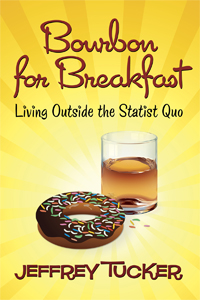
Pirated from the book: Bourbon for Breakfast: Living Outside the Statist Quo by Jeffrey Tucker
Published here without permission because we’re BAD Quakers!

Bourbon for Breakfast: Living Outside the Statist Quo by Jeffrey Tucker

Who Was Beowulf?

It took twice through, but I’m finally convinced; Beowulf is a wonderful film. There is plenty to recommend it, even if it had stuck to the original plot line.

Nearly every frame is beautiful and riveting. The visuals seemed to have borrowed from the field of gaming, so you can never quite tell if what you are looking at is real or animated. The music is a kick. Beowulf is himself thrilling to watch, as are the monsters, dragons, swords, and, above all, the time: it is set in the 6th century Scandinavia. The viewer is convinced that it must have been something like this.

Having read the newest translation several years ago, by Seamus Heany, I was not prepared for how the film would change the plot, which is rather linear and boring in the original, but, hey, it’s the 10th century, so who can complain? A monster vexes a town. Beowulf arrives and kills it, kills the monster’s mother, and becomes king and then does other amazing things before he dies a heroes death.

In the new film version, this is a remarkable undercurrent. Hrothgar, the king that comes before, has a hidden secret and it deals with the monster’s mother. It seems that Grendel is his offspring, and the witch, played by Angelian Joli, is irresistible to him, and, later, to Beowulf. Bourbon For Breakfast Beowulf kills Grendel and then sets out for the mother, who seduces him into giving her yet another offspring that will return to torment the community many years later. Beowulf lies, however. He had given in to her, but only tells everyone that he killed her.

His secret is known only to a few: his wife and his closest associate. Both decide not to pass it on. He is a hero and generations will sing his praises. So declare these court historians, and so it was to be, in the official version. And so the official version has stood.

There is a profoundly moral story here, much like Faustus. What we see are the dreadful consequences of sin visiting themselves on many more than just the sinner. The family is destroyed. The community is destroyed. The path of history is distorted from its rightful journey toward justice and truth onto another path of betrayal, hurt, suffering, violence, degradation, and ruin.

Yes, the moral can be described as Christian, and rigorously so. Indeed, there is an overtly Christian theme in the movie. In an early scene, the king is asked whether they should pray to the new Roman God named Jesus Christ. No, he says, they don’t need Jesus; they need a hero. Later in the film, the man who asks the question carries a crucifix, and, even later, becomes a Christian monk, working to convert the community and successfully so. (Why the Christian Right isn’t heralding this movie is unclear.)

Is this just another case of hero debunking in an age of cynicism, in which authentic virtue is a myth and there is no one to admire? I don’t think so. What’s at stake here is the reputation of leaders, who are a special breed. The state organizes itself in order to celebrate itself. It rules with the consensus of society, which also desires to celebrate the state and its leaders. The head of state has to work very hard not to emerge from this conspiracy as a hero.

We don’t have to look far for examples. See Mount Rushmore. Are we really suppose to believe the maniac, power-mad Theodore Roosevelt is godlike? And let’s consider people who in private life would be considered gangsters, thieves, liars, and murderers, men such as Abraham Lincoln and Franklin Roosevelt. How is it that they came to have their images on our nation’s money, that their glorious stories are taught to all American schoolkids? That their lives are held up to us as models of virtue and glory?

The underside of government leadership is the primary subject of all revisionist history, and this form of history is something we should always give some benefit of the doubt. It is the official story of the heroism of leadership that we should suspect. This is true even with such untarnished demigods like George Washington, who, by all revisionist accounts, was an incompetent general, a man who had no sympathy for the original American idea, who jumped at the chance to send in the troops to put down a tax rebellion. The father of our country? Come on.

Have you visited the Lincoln Memorial? Pure paganism, wrapped in state worship. There he sits in the Temple of Democracy, with his hands on the fasces, ruling us from the Heavens to which he clearly ascended after his martydom – the glorification of power on display for all to us. The tourists come and the tourists go. They figure the Lincoln must have been pretty marvelous and think nothing more about it.

So it might have—must have been—with Beowulf, the great warrior who became the king. We know and do not question the version of history handed down to us. We take his ancient hagiographers at their word. But what was the truth? The film provides a credible alternative history, but whether or not this is the true story, the message is one we need to hear: power corrupts. If we care about truth, we need to look at this corruption in its face, and learn from it, and not merely believe what the court historians, from our time or the 10th century, have told us.

Jeffrey Tucker
managing editor Sacred Music journal and polyphony director St. Cecilia
editorial vice president of the Ludwig von Mises Institute

Author:Jeffrey Tucker
Sing Like a Catholic
Bourbon for Breakfast: Living Outside the Statist Quo

https://mises.org/resources/5509/Bourbon-for-Breakfast

https://www.chantcafe.com/

Posted in Bad Quaker Fun, History, The Campfire | Tagged , , , , | 1 Comment

A Natural View of Rights, Instinct, and Law

A number of respected writers have spent far more time than I examining this topic and expounding their thoughts clearer than I have the ability to do. That said, I hope that I can add something to the discussion that’s worth reading.
I will be blunt in this; My intention is to take three common terms and twist them into the same origin without damaging their individual aspects. They are instinct, natural law, and rights.

I’ve had the opportunity in the last few years to observe common yard animals interacting in various situations and I have come to the conclusion that all animals that interact with other animals are governed by natural social laws. I believe these laws are specific to each type of animal. That is to say, the laws that govern the social habits of the squirrel are in no way binding to the hawk. It is therefore imposable for the squirrel to infringe on the rights of the hawk. And it’s foolish to judge the actions of the hawk by pointing out the instincts of the squirrel. Often confused humans attempt to bestow human rights on specific animals, but not only is it illogical it’s unnecessary. So take a moment and read these comparisons of some common animals.

The Common Tree Squirrel of Western Ohio:
I find squirrels are governed by a far more complex set of natural laws than I previously thought. For example, the gender of the squirrel has little or nothing to do with the size and strength of the squirrel so they display a true equality between the sexes. Although the male pursues the female in the courtship and may use enticements to win fair maiden, the female has absolute veto rights. Any male who attempts to override this right risks a nasty fight and, although sparing is common among squirrels, true fights are rare because of the risk of serious injury. Non-mating squirrels rarely allow another squirrel to come closer than a body lengths distance during regular daily activities. Yet when the weather turns bad or on a cold night, a group will snuggle up in a ball and keep each other warm and safe. They adhere to a social hierarchy that is difficult to observe do to the similar appearance of each squirrel, however identification doesn’t seem to be a problem for the squirrels themselves. They maintain a wide network of communication and are quick to give verbal and visual alerts as any danger is perceived.
They also have an efficient method of passing an alert around a wide geographic area, depending on the nature of the threat. But when a food source is discovered the individual squirrel has no obligation to any other squirrel to share the discovery. However a single male can be observed leading a female to a food source in order to win her favors. Squirrels are astute observers of other squirrels and have no moral objection to burglarizing the stash of any other squirrel thereby showing no regard for the property or social status of the individual. Oddly enough, I have never observed a direct assault style robbery of a weaker squirrel by a dominate squirrel. Lastly, I have never observed a squirrel fight directly involving more than two squirrels. In other words, I have never seen two or more squirrels join to attack a single squirrel. And I have never seen a squirrel kill another squirrel.

Wrens and Sparrows of Western Ohio:
The wrens and sparrows in my yard nest, roost, and feed together and, other than mating, don’t seem to discriminate among themselves. They don’t seem to notice the doves that walk around them and I have even observed a starling that had been ostracized from the local starling flock, accepted socially among these little tweety birds. I have not been able to distinguish any hierarchy. If they’re feeding in the lawn or at a bird feeder they seem to share the watch duty and the feeding rights equally. However, if I chop up bread and pile it on my driveway they will prefer stealing directly from the beak of another bird rather than picking up a chunk of bread that is at their feet. When such a robbery takes place no bird involved seems even the slightest put off over it. However, for reasons I can’t grasp, capitol punishment is common among them. I have been unable to determine what infraction prompts the punishment but, as if on signal, the flock will violently fall upon a single bird and kill it. I conclude, the individual bird has no right in property, even the property of its own life.

The Blue Jay of Western Ohio:
I have found the blue jay to be amazingly communal and yet fiercely territorial with a sense of private property. If one jay discovers a food source, say peanuts that I have thrown out for them, he is expected to clearly and loudly announce his find. He is not to partake of his find until he hears the acknowledgment of his fellows in the distance. And yet, I have observed individual Jays that cheat on this rule. Additionally the individual Jay will fight for his own peanut. Lastly, though I have seen Jays fight, I have never seen them gang up on one Jay or kill a fellow Jay. I conclude by this that Blue Jays have property rights of a sort unique to Blue Jays.

Lastly, lets talk about dogs and cats;
Dogs are domesticated wolves. Wolves, that we have chosen for a variety of reasons, selectively bread and cross bread to obtain exactly the kind of companion we want. Bread to have more puppy like characteristics than mature wolves, in the size, shape, and color that appeals to us. A dog is, over generations, made more and more dependent on his master for food, housing, warmth, grooming, and security, yet maintaining an adherence to the wolves’ natural law of the pack that endears it to us and us to it.
Cats, of course, are vastly different from dogs and lack entirely natural pack tendencies. But remember, if a domesticated cat or dog kills one of the squirrels or the birds listed above we would never think for a moment that the dog or cat had violated any law or committed any sin. They simply obeyed a natural instinct. No rights were violated! On the topic of property, both dogs and cats display a clear understanding of their rights. In territory, objects, and their own bodies, property rights could be called “fully developed” in both kinds of animals.

I could go on and on with this topic and not get to my point, so allow me to sum up.
Each and every one of these groups of animals have strict natural laws that govern their behavior. These laws are not written down. They are not voted on. There is no elite nor elect establishing law and jurisdiction. There is no enforcement squad with special colored feathers or fur. Their own respective laws are collectively enforced by the community while never violating the rights of the individual. It is as if there is an invisible hand, guiding their interactions. Additionally, if these different groups of animals were to act against their natural instincts they would, in all likelihood, not survive.

If we then can see that each kind of animal is governed by natural inherent laws unique to their group and that their survival is guided by and dependent upon these instinctual laws, then we must assume that we humans are likewise bound by natural laws unique to us. Laws that exist simply because we exist and that they must be embedded instinctively in us individually. Survival Gear Bags These laws must then be inalienable to humans. They exist whether written or not. They are not dependent upon election. They don’t require authorization by some authority. They are because we are! And by their nature and origin, they supersede all restrictions and standards of behavior created by a single human or a group of humans no matter the intent or purpose of the group or individual!
Some have famously stated that among these rights are life, liberty, and the pursuit of happiness, but of course we understand that is quite the understatement and merely a simple overview not intended as all inclusive. The modern libertarian bases his world view upon these natural rights and laws.
At times, conversation with individuals who are not as familiar with these concepts has caused confusion. Someone may believe they have a right to this or that when in fact no principle for such a right exists. Someone else may insist this or that is against the law by referring to an agreement by persons in a far away city. Someone else may even quote words written on paper as proof of a particular right, when in fact writing words on a paper has no power to instill a right or make a law. Under different circumstances a libertarian may insist they have the right to own such and such or the right to do this or that or go here or there unhampered while the less informed insists that its not lawful. This confusion comes from people who hold opposing world views while using the same words to describe very different things.

For the libertarian, law and rights can be summed up thusly; I have a right to own property. No one can lawfully use force or fraud to take my property. My property consists of that which I was born with (my life and my body), and that which I have been given as a gift, obtained through trade, or obtained through homestead. I am bound by law to respect the property rights of others if I am to expect others to respect my rights. If I violate the rights of others I should expect to compensate the person or persons that I have harmed. If my actions have not infringed upon the rights of someone else, I have not broken the law.
The libertarian views this as natural law and views all agreements, arrangements, and enforcements outside of natural law to be lesser or completely lacking justification. A person who doesn’t accept natural law or doesn’t accept it completely, will in all likelihood recognize law as being that which the State decides upon and enforces. This is a fundamental difference in philosophy so profound that it has the power to drive a wedge between the proponents of these opposing views.

A great example of the difference in philosophy is the current debate over marijuana.
Some will say that this weed must never be legalized! It is harmful and leads to all kinds of bad things. It causes the breakdown of family units and promotes dangerous behavior.
Some will say this plant should be legalized. They announce its positive uses, its relative harmless effects, and they compare it to substances already allowed by the State such as beer or aspirin. They will bring up the fact that if it were decriminalized, violent gangs would be denied hundreds of millions of dollars a year in revenue and additional millions would be saved by law enforcement and the jails. The plant could be taxed like tobacco and regulated just like rum or prescription pain relievers.
Both these arguments assume the State is the source of law. They may both have valid points, but the heart of their stand is based on the premise that the State has not only the right but the responsibility to decide what a person can do with their property. Therefore the right of property is not the right of the individual, it is the right of the State, or at best a group of other people.
Now please don’t get me wrong. Some libertarians including myself, make the statist argument when debating a statist. Often the statist will never be converted to liberty and the only argument they will ever understand is one based on their own statist philosophy. In the Bible story of Paul converting Greeks to Christianity, he went to their temple and expounded to them the gospel of the “unknown god”. Even though he was a trained rabbi, he didn’t condemn them for idolatry and demand they rip down their temples and obey the Ten Commandments. He utilized their belief system, already in place, to show them that a vast leap of faith was not needed. If they just took one step at a time they could reach Christianity. Paul only sought to change individuals in the Greco/Roman world, but in doing so he was planting the seeds of destruction of the empire itself. Lovers of liberty must do the same. We must bring the concepts of liberty to a statist society in a non-threatening way, even though liberty threatens the State right to its core.

So each and every Son and Daughter of Liberty can look to a tree or a bird feeder and observe natural law and individual rights being guided by the invisible hand. Then with a small step of faith we can understand that simple transactions between people are guided by that same hand in a way instinctual to all people. We can see that within our very nature resides the law that governs us. If we step further along this path we can begin to understand that if we interfere with those natural rights and laws with man made laws and rights, we threaten our future and our survival. And if you’re still with me on this path, its not hard to understand that almost every threat humans face today is a result, on some level, of the abandonment of natural law for the embrace of man made law. When we prefer the narcotic of the State to a field of wild poppies we numb ourselves until we no longer remember who we are or where we were going.

Ben Stone
Updated 2011Ben

Posted in Bad Quaker and Sin, Free Society, Property, Voluntaryism and Competitive Government, Voluntaryism and Law, Voluntaryism and Social Interactions, Voluntaryism and the Zero Aggression Principle | Tagged , , , , , , | 2 Comments

Weekend Post

Bad Quaker’s Weekend Post

The headline reads “Three largest online poker sites indicted and shut down by the FBI”
PokerStars, Full Tilt Poker, and Absolute Poker attacked by government goons as the State seeks $3 billion from the companies!
Read that again! $3,000,000,000!

Being a subscriber to some of these sites, its my opinion that this is bogus.
I think this is just crap!
For me, playing online poker was a way of seeing if I had what it took to be a true table poker player. I could do this without any investment of actual money and without any real risk. This is a mater of skill and not luck.
When you play the lottery or a slot machine you are just playing luck. But table poker is skill.
Table poker is more like horse racing than a lottery or a slot machine. You have variables that are based on current conditions and those conditions change constantly. How well you perceive and adjust to those conditions determines your success or failure.
But the State wants $3 billion in free cash! So all argument stops.
Hundreds of thousands of players who never did anything wrong are punished so the State can make its point and collect $3 billion.
So I have a question; Has the FBI moved its headquarters to New Jersey yet?
Should we expect the FBI to muscle into the trash removal business or perhaps unions?
Will the FBI start offering “protection” to businesses that are “cooperative”?
Oh, my bad. They do that already with their preferred Mexican cartels in the “import” business. A business the Old Families would never has dirtied themselves with.

Bad Quaker Staff Contribution.

Posted in Bad Quaker and Taxes, Brief Articles and Short Notes, Free Society, The Campfire | Tagged , , , , , | Comments Off on Weekend Post